AFF222 Flow Through Particle Layers Didactic Equipment Vocational Training Equipment Fluid Lab Equipment
1. Product Introduction
1.1 Product Description
Flow-through particle beds are widely used in engineering and process technology. In reactors, liquids and gases flow through fixed beds and fluidized beds. Another application area is the separation of solid particles from suspensions through sedimentation and deep filtration.
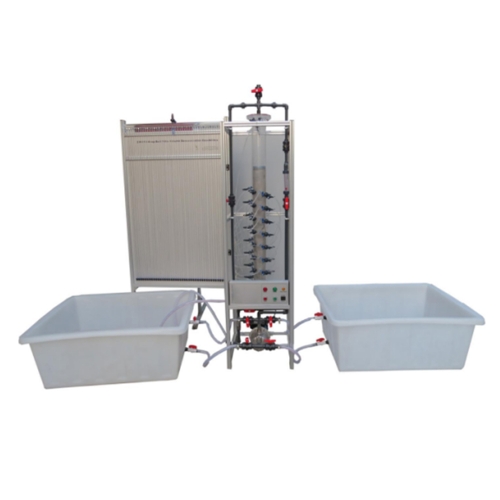
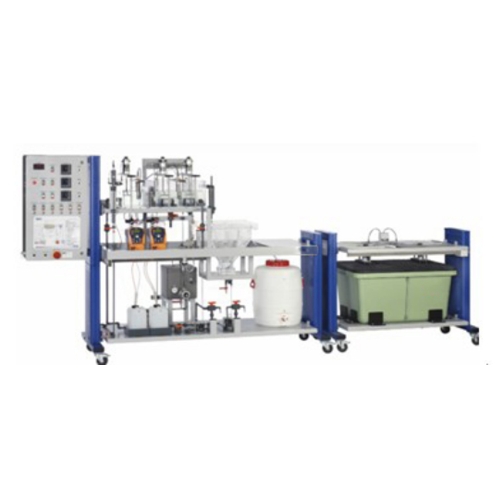
This experimental setup can be used to study the fluid dynamics principles associated with flow-through of fixed and fluidized beds. For this purpose, the experimental setup provides a fillable glass test tank through which water can flow from both ends. Sintered metal plates serve as supports for the bulk material. Water from a laboratory water supply system enters the test tank.
To study flow-through of a fixed bed, water enters the test tank from above. It flows through the fixed bed and sintered metal plates, then through a distributor to the outlet. The experimental setup can be modified using quick-connect fittings. This also allows reversing the direction of flow through the test tank to study fluidized beds.
Water flows upward through the porous sintered metal plates and the fixed bed. If the water flow velocity is below the so-called fluidization velocity, the water will flow directly through the fixed bed. When the water flow velocity is higher, a fluidized bed is formed. Water then flows from the top of the test tank into the expansion tank and exits from there.
Regardless of the specific configuration, the flow rate is regulated by valves and indicated by a flow meter. To determine the pressure loss in a fixed or fluidized bed, we provide two pressure gauges with different ranges. The required pressure gauge is selected via the valve.
1.2 Product Features
1. The product boasts an excellent, aesthetically pleasing design.
2. The equipment is made of transparent materials, allowing for clear visibility of the experimental process.
3. The product uses more durable materials, significantly extending the equipment's lifespan.
4. It can perform a wide variety of experiments, exploring factors influencing the fluidization of solid particles.
2. Technical Specifications
2.1 Technical Parameters
Operating Environment Requirements:
Ambient Temperature: 10℃~30℃; Relative Humidity: < 75% (at 25℃).
2.2 Dimensions and Weight
Dimensions: 1150mm×690mm×410mm
Weight: Approximately 15kg
3. Product Component Names and Functions
3.1 Main Body of the Product
No. Name Qty
1 Level differential pressure gauge vent valve 2
2 Level differential pressure gauge 1
3 Mechanical differential pressure gauge 1
4 Expansion tank 1
5 Drain outlet 1
6 Expansion tank inlet quick-connect interface 1
7 Reactor vent valve and plugging structure 1
8 Reactor 1
9 Water supply end distributor block 1
10 Flow meter 1
11 Flow regulating valve 1
12 Low-pressure distributor block 1
13 High-pressure distributor block 1
3.2 Product Accessories
No. Name Qty
1 Graduated steel ruler 1
2 Sand bags (1–2 mm particle size; weight: 0.5 kg) 1
3 Glass bead bags (420–590 microns particle size; weight: 1 kg) 1
4 Glass bead bags (180–300 microns particle size; weight: 0.5 kg) 1
5 20mm water pipe (2 meters) 1
6 16mm water pipe (2 meters) 1
7 1 set of Allen wrenches 1
8 Quick couplings (rubber nipple couplings, copper) 1
9 Quick couplings 4-point water connectors 1
10 Quick couplings (nipple couplings, copper) 4-point internal thread 1
11 Quick couplings (copper) 4-point external thread 1
12 Pipe clamp 5
4. List of Product Teaching Experiments
(1) Fundamental Study of Fixed Bed and Fluidized Bed Flow (Darcy's Law)
(2) Determination of Permeability Coefficient
(3) Observation of Fluidization Process
(4) Relationship between Pressure Loss and Flow Rate, Particle Type, Particle Size and Bed Height
(5) Determination of Fluidization Velocity and Comparison with Theoretical Values
(6) Verification of Carman-Kozeny Equation



 Login
Login  Inquiry List